What is the difference between a salt chlorinator and traditional chlorine treatment?
The main difference lies in how the chlorine is supplied.
Traditional pool sanitization methods require the periodic manual addition of chlorine products based on water quality. In contrast, a salt chlorinator automatically generates chlorine using the equipment itself.
Traditional Chlorine System
Requires manual addition of chlorine
Relatively lower initial equipment investment
Requires regular water quality testing and adjustment
Chlorine levels may fluctuate depending on the dosing cycle
Suitable for both residential and commercial pools
Salt Chlorinator System
Automatically generates chlorine
Reduces the frequency of manual sanitizer dosing
Helps maintain a more stable chlorine supply
Requires installation of an electrolytic cell and control system
Requires maintaining appropriate salt levels
Electrolytic cell requires regular inspection and maintenance
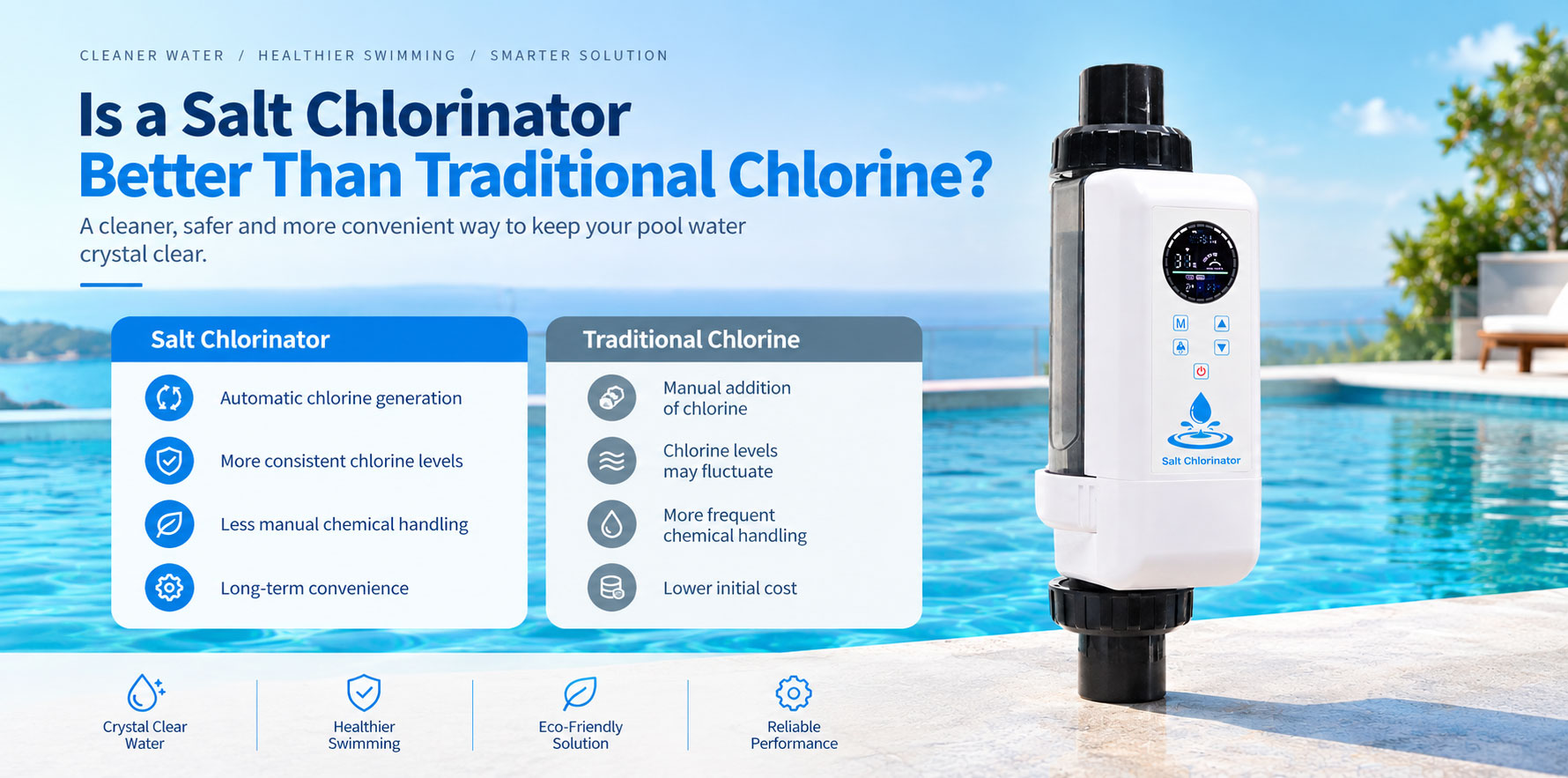
Is a Salt Chlorinator Better Than Traditional Chlorine?
If "chlorine" here refers to the traditional manual dosing method, then a salt chlorinator offers clear advantages in terms of automation and ease of use.
Traditional methods require users to manually add chemicals based on water quality test results, whereas a salt chlorinator generates chlorine continuously while the pool circulation system is running, thereby reducing daily maintenance tasks.
This method is more convenient for residential pool owners looking to minimize the frequency of manual maintenance.
For hotels, resorts, water parks, and other commercial pools, automated chlorine production can also help streamline daily pool management.
However, this does not mean a salt chlorinator is necessarily the best choice in every situation.
For example, traditional chlorine systems are advantageous for small pools or budget-constrained projects due to lower equipment costs and simple installation. Conversely, for pools where increased automation and reduced manual labor are desired, a salt chlorinator may be a better fit.
Therefore, rather than simply asking "which is better," consider:
Which chlorine sanitization method is best suited for my pool?
Key Advantages of a Salt Chlorinator
1. Automatic Chlorine Generation
Automation is one of the primary reasons for choosing a salt chlorinator.
Once installed and correctly configured, the system automatically generates chlorine while the pool circulation system operates, reducing the need for manual sanitizer additions.
For large residential and commercial pools, this effectively lowers the daily maintenance workload. 2. More Stable Chlorine Supply
With manual chlorine dosing, chlorine levels in the water can spike initially and then gradually drop as disinfection proceeds and the pool is used.
A salt chlorinator generates chlorine continuously based on the system's operating status, helping to maintain relatively stable disinfection levels.
Of course, actual chlorine levels are still influenced by factors such as pool volume, water temperature, bather load, circulation time, and water quality; therefore, regular water testing remains necessary.
3. Reduced Manual Chemical Handling
Traditional chlorine products require storage, handling, measuring, and manual dosing.
Using a salt chlorinator minimizes the need for frequent contact with and manual addition of chlorine products, offering greater convenience for users looking to simplify their pool maintenance routine.
4. Suitable for Long-Term Automated Operation
Compared to basic manual chlorination methods, salt chlorinators typically require a higher initial investment in equipment.
However, for users who prioritize automation and long-term convenience, the reduction in daily manual labor makes this equipment a valuable long-term investment.
What Are the Drawbacks of Salt Chlorinators?
While salt chlorinators offer the advantage of automation, it is important to understand their limitations before purchasing.
Higher Initial Investment
Salt chlorinator systems typically require components such as a controller and an electrolytic cell, resulting in higher upfront costs compared to simply purchasing chlorine products.
Electrolytic Cell Maintenance
The electrolytic cell is a critical component of the entire system.
Over time, scale and other deposits can accumulate inside the cell, requiring inspection and cleaning based on actual water quality conditions.
Maintaining Proper Salt Concentration
Salt chlorinators must operate within a specific salt concentration range.
Consequently, users still need to regularly monitor the pool's salinity levels and add salt when necessary.
A Salt Chlorinator Does Not Mean a "Chlorine-Free Pool"
This is one of the most common misconceptions among consumers.
A saltwater pool does not mean there is no chlorine.
In fact, salt chlorinators work by using salt to generate chlorine. Therefore, the pool still relies on chlorine for primary disinfection; the difference is simply that the chlorine source shifts from manual addition to automatic generation by the equipment.
Salt Chlorinator vs. Chlorine: Which Should You Choose?
Different solutions are suitable for different application scenarios. For residential pools, a salt chlorinator is a solution worth considering if the user wants to reduce the frequency of manual chemical dosing and increase the level of automation in pool maintenance.
For commercial pools, hotels, resorts, and water parks, automatic chlorine generation can reduce manual labor; however, equipment selection must carefully consider chlorine output, pool capacity, water quality conditions, and local regulations.
For budget-sensitive projects, traditional chlorination methods retain an advantage due to their lower initial investment costs.
For pool equipment distributors, brands, and contractors, salt chlorinators represent a key category within the market for automated pool water treatment products.
What should you look for when buying a salt chlorinator?
If you are comparing different salt chlorinator manufacturers or suppliers, you should not focus solely on chlorine output.
It is recommended to evaluate the following factors:
Chlorine production capacity
Suitable pool capacity
Required salt concentration
Quality of the electrolytic cell
Control modes
Timer functions
Pipe connection specifications
Salinity and water temperature detection
Installation requirements
Electrolytic cell replacement cost
Warranty
Certification
OEM/ODM customization capabilities
B2B buyers should also consider factors such as MOQ (Minimum Order Quantity), samples, lead times, packaging, private labeling, and long-term supply reliability.
If a supplier offers various chlorine output specifications and supports OEM/ODM customization, it becomes easier for pool equipment distributors, brands, major retailers, and contractors to develop products tailored to specific market needs.
Conclusion
So, is a salt chlorinator better than traditional chlorine?
Strictly speaking, a salt chlorinator is not a method that eliminates the use of chlorine; rather, it is a technology that automatically generates chlorine from salt.
Compared to traditional manual chlorine dosing, salt chlorinators offer distinct advantages in terms of automation, reduced manual labor, and continuous chlorine generation. However, they also require a higher initial investment and necessitate regular maintenance of the electrolytic cell and monitoring of salt levels.
Ultimately, the choice of method should be based on factors such as pool size, application scenario, maintenance requirements, budget, and long-term operational needs. When selecting a salt chlorinator, distributors, contractors, purchasers, and brand clients should look beyond price and comprehensively evaluate factors such as chlorine output, system compatibility, product reliability, OEM/ODM capabilities, warranty terms, certifications, and the supplier's long-term supply capacity.