How Does a Salt Chlorinator Work?
A salt-chlorine generator, also known as a salt-chlorine generating device, converts dissolved salts in swimming pool water into chlorine through electrolysis.
This system eliminates the need for manual addition of chlorination chemicals; instead, chlorine gas is continuously generated as the pool water circulates within the electrolytic cell.
The working process is relatively simple:
From salt to chlorine:
The working principle of a pool chlorinator can be simply understood as: "Constantly converting brine into chlorine through electrolysis, which then returns the chlorine to the water circulation system to complete the disinfection process."
Pool Chlorinator Working Process
① Adding Salt to the Pool → ② Water Circulation → ③ Chlorine Production by Electrolysis → ④ Disinfection and Sterilization → ⑤ Chlorine Reduction to Salt → ⑥ Continued Circulation
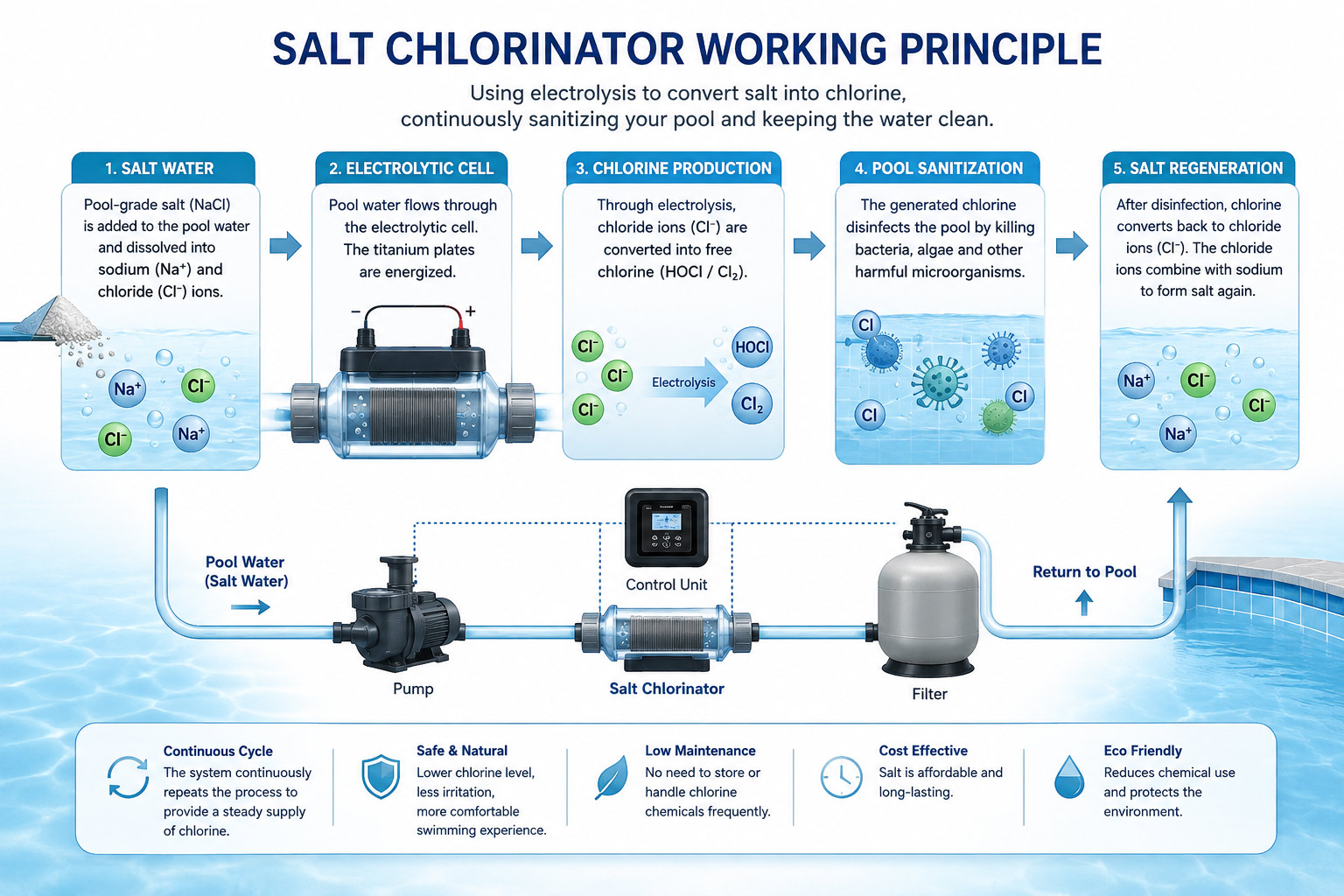
1. Add Salt to Pool Water
First, add an appropriate amount of pool-specific salt (usually high-purity, iodine-free sodium chloride) to the pool water. The salt dissolves, forming a brine containing sodium ions (Na⁺) and chloride ions (Cl⁻).
2. Pool Pump Circulates the Water
The pool water enters the filtration system through a circulation pump and then flows through the electrolytic cell of the chlorinator.
3. Electrolytic Cell Produces Chlorine
This is the core component of the chlorinator.
In an electrolyzer, titanium electrodes (multiple metal electrode plates, typically made of titanium) undergo an electrochemical reaction when electricity is applied, converting chloride ions in the water into chlorine, which has disinfecting properties. In actual systems, hypochlorous acid (HOCl) and other available chlorine species are formed.
This can be simply represented as:
Salt Water → Electrolysis → Free Chlorine
4. Chlorine Sanitizes the Pool
The generated available chlorine returns to the pool with the water flow, oxidizing and disinfecting bacteria, algae, and other microorganisms in the water, thus helping to maintain pool water cleanliness.
5. Chlorine Eventually Converts Back
After disinfection, chlorine gradually converts back into chloride ions. Chlorine ions recombine with sodium ions to form salts, allowing the salt-chlorination system to operate continuously in the pool's circulating water.
6. Continuous Circulation
As long as the circulating pump and salt-chlorinator operate according to the settings, the system can continuously repeat:
Salt → Electrolysis → Chlorine → Sanitization → Salt
This is also one of the key features of the salt-chlorinator compared to traditional manual chlorination products—it automatically generates chlorine through electrolysis, replacing the need for manual chlorination.